A closer look
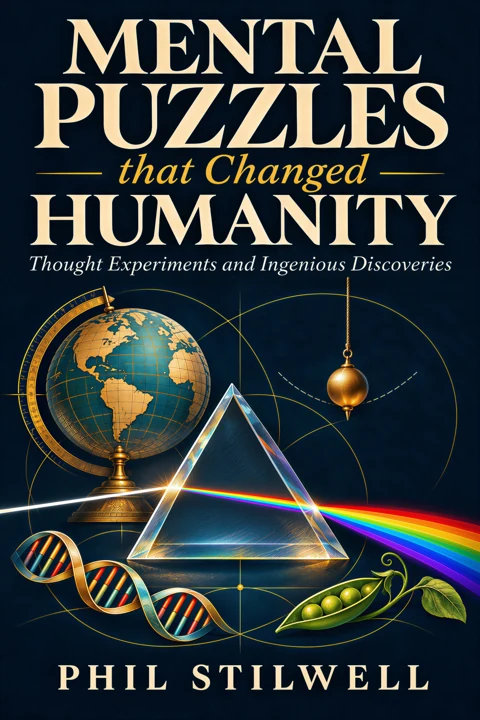
A discovery can look inevitable once someone has explained it. Before the answer existed, however, there was a puzzling observation, an awkward constraint, or a question that seemed impossible to settle. This book returns to that earlier moment. It introduces the situation, gives you something manageable to consider, and then follows the reasoning that made a new answer possible.
The 120 chapters range across science, mathematics, psychology, technology, and collective decision-making. You might compare shadows, inspect a medical comparison, follow a path through a network, or consider what a message must contain to survive an error. The aim is participation without pressure: a useful question can open an idea even when its full consequences are demanding.
A small move before a large discovery
Each challenge offers a reader’s move: a comparison to make, a possibility to test, or a missing case to notice. Two optional hints provide help before the separate reveal. Difficulty guides let you choose a comfortable starting point, while the explanations and illustrations help connect the initial puzzle to the broader result.
The format welcomes several kinds of reading. Try a solution, borrow a hint, or enjoy the historical story and explanation. Diagrams have captions that direct attention to the relevant relationship, so the pictures contribute to the reasoning instead of simply decorating it.
Ideas across disciplines
The journey includes measuring Earth, testing how DNA copies itself, investigating the structure of the planet, and reconsidering space and time. Other chapters explore attention and memory, mathematical limits, computation, information, cooperation, and fairness. Their variety makes it possible to notice similar reasoning moves in very different settings.
The book also distinguishes the tools being used. An experiment investigates what happens in nature; a proof establishes what follows from assumptions; a thought experiment explores an imagined situation; and a model simplifies a system. Understanding those differences helps you judge what each discovery does, and does not, establish.
The people, the consequences, and your next question
Historical context and a discussion of each idea’s consequences place the puzzle within a larger human story. Discoveries appear as work shaped by earlier knowledge, available tools, and difficult assumptions. Source notes and further-exploration links provide routes beyond the introductory treatment.
Curious general readers can follow the sequence or browse by interest. Across the collection, recurring habits become visible: hold a condition steady, look for a rival explanation, change the question, or count what an appealing story leaves out. Those habits matter well beyond the original discovery.
Ready to turn the page?
Find this book on Amazon