A closer look
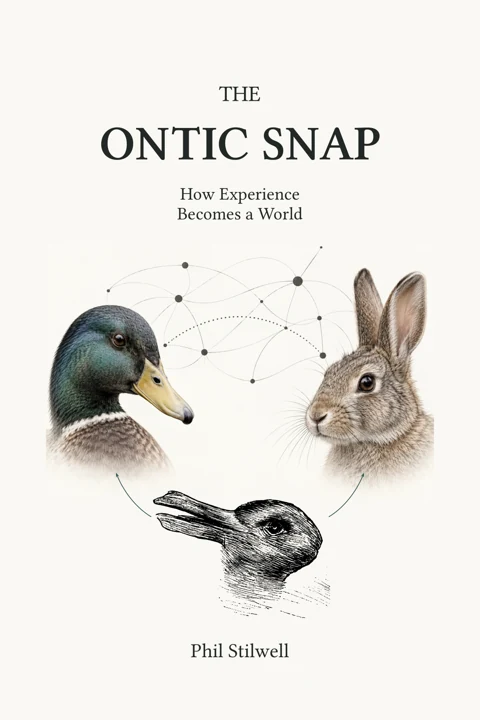
Look at a drawing that can appear as either a duck or a rabbit. The marks stay fixed, yet what you see changes. That familiar puzzle opens a wider question: how do incomplete cues become an apparently settled object, event, or situation? Ordinary recognition reaches beyond what is immediately available, drawing on expectations whose history we rarely notice.
The book calls an interpretation’s arrival at this organizing role an “ontic snap.” The term describes how a possibility comes to support further expectations, judgments, or actions. It is a philosophical proposal about our working experience of the world. The account does not claim to have discovered a single brain mechanism or a universal instant when recognition happens.
The history inside a moment of recognition
The opening chapters connect learning from experience with the search for an explanation that fits present circumstances. The latter activity is called abduction: considering what could make sense of the evidence. A familiar sound, an ambiguous word, or part of an object can become intelligible because it belongs to a wider web of learned relationships.
This process can support dependable recognition or an attractive mistake. The interpretation that feels most compelling is not automatically the one that deserves the greatest confidence. The book keeps psychological familiarity and evidential justification in view as distinct questions.
Correction, skill, and a shared world
A coat in a dim room can first appear to be a seated person. Better lighting changes that interpretation while leaving the room, chair, and much else intact. Such cases show that revision need not dismantle everything we understand. What matters is how a settled view responds when conditions improve or new evidence arrives.
Other chapters examine a mechanic learning to notice a wheel’s movement and customers recognizing a queue. These scenes explore how training, useful feedback, and shared practices make relationships visible. Experience becomes informative when it gives people ways to distinguish a successful judgment from a confident habit.
A framework open to examination
The discussion of reality asks how selective, revisable representations can still tell us something dependable about the world. A map omits enormous detail without making the coast imaginary. That distinction supports the book’s effort to take interpretation seriously while retaining meaningful standards of accuracy and correction.
Appendices provide a compact argument, an illustrative calculation about a wet path, possible research designs, and a glossary. These resources make the proposal easier to inspect and identify where further testing would be needed. General readers interested in perception and knowledge can follow the argument without treating its vocabulary as an established scientific verdict.
Ready to turn the page?
Find this book on Amazon