A closer look
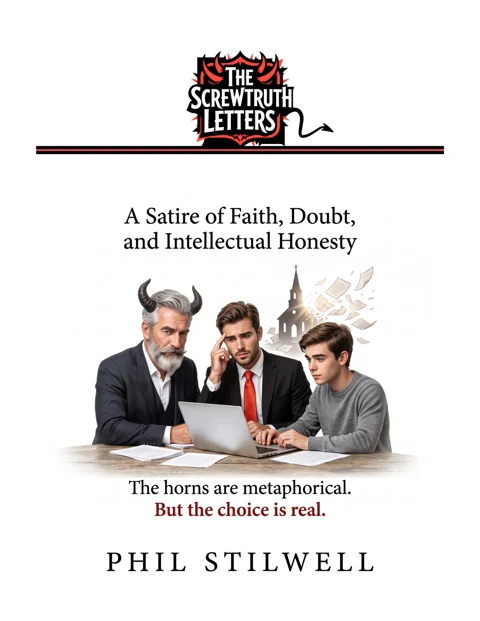
Screwtruth once defended Christian doctrine for a living. Now churches pay him to present skeptical objections so their defenders can rehearse their replies. The institutions regard his arguments as useful practice; he regards the arrangement with considerably more irony. When Pastor James Driftwood seeks his advice, an exercise in defending belief becomes an increasingly personal examination of what continued belief demands.
The catalyst is Billy Henderson, a sixteen-year-old whose questions concern prayer, divine silence, and the claims made about Jesus. Driftwood cannot dismiss those questions as mere rebellion. He also cannot consider them apart from his pulpit, his marriage, and his seminary debt. Phil Stilwell gives this conflict a grotesque fictional expression: sustained intellectual dishonesty can produce horns. The absurdity makes the ordinary pressures behind it harder to overlook.
An argument carried by correspondence
The email exchanges allow three different relationships to doubt to develop alongside one another. Screwtruth has already lived through a crisis; Driftwood is caught inside one; Billy is asking what the others have learned to defend or evade. Their contrasting voices give philosophical disputes immediate personal stakes. Illustrations and dark humor accompany a story about maintaining an identity when the reasons supporting it begin to fail.
This is skeptical fiction with an argument to make, rather than a neutral survey of Christian belief. Its dramatic interest lies in the distance between what a character can say publicly and what that character finds credible privately.
The doctrines under examination
Early exchanges examine how certainty earns approval, how belief can be protected from contrary evidence, and how doubt can be treated as a personal failing. Later discussions turn to the incarnation—the claim that Jesus is fully human and fully divine—punishment transferred to an innocent substitute, and eternal conscious torment. The book asks whether the defenses offered actually answer the difficulty or preserve confidence by changing the subject.
Beyond the story
A mock medical appendix elaborates the fictional horn-growing condition. A separate appendix presents formal logical demonstrations of the author’s objections, while a personal afterword connects the story to the question of intellectual integrity. An annotated bibliography includes both critical works and sophisticated defenses of the doctrines being challenged, giving readers routes into the disagreements behind the satire.
Readers interested in religious questioning, philosophical fiction, or the social cost of changing a conviction can approach the book through its characters, then pursue its arguments in greater detail. The humor remains attached to a serious concern: how difficult honest speech can become when relationships and a livelihood depend on familiar answers.
Ready to turn the page?
Find this book on Amazon